Most exterior paint failures in Florida aren’t caused by bad paint; they’re caused by the wrong paint for the environment it’s asked to survive in. Between intense UV exposure, near-constant humidity, and salt air in coastal areas from Broward County to Lee County, Florida’s climate is one of the harshest paint-testing environments in the country. What holds up beautifully in a milder climate can chalk, blister, or fade within two to three years here.
After 20+ years painting HOA communities, commercial properties, and homes across Florida, we’ve seen firsthand which products and application methods actually last — and which ones look good on the sample card but fail within a single humid summer.
Why Florida's Climate Is So Hard on Exterior Paint
Three environmental factors work against exterior paint simultaneously in Florida, and most paint failures come from at least one of them being underestimated:
UV Intensity. Florida receives some of the most direct, sustained sun exposure in the continental U.S. UV radiation breaks down paint binders over time, leading to chalking (a powdery surface residue) and fading, especially on south- and west-facing walls.
Humidity and Moisture Cycling. Florida’s air holds significant moisture almost year-round. Paint that can’t “breathe” — allowing moisture vapor to pass through rather than trapping it against the substrate — leads to blistering, peeling, and mold growth underneath the paint film itself.
Salt Air Corrosion. For properties within several miles of the coast, airborne salt accelerates the breakdown of lower-grade paint films and can corrode fasteners and trim if the paint system doesn’t include proper priming and sealing.
What to Actually Look for in Exterior Paint
Rather than judging paint by brand name or sheen alone, HOA boards, property managers, and homeowners should evaluate products against a few specific performance criteria.
100% Acrylic Resin (Not Vinyl-Acrylic Blends)
100% acrylic paints offer significantly better flexibility, UV resistance, and moisture permeability than vinyl-acrylic or lower-cost blends. This flexibility matters because Florida buildings expand and contract daily with heat cycling — a rigid paint film will crack faster than a flexible one.
High Solar Reflectance
Paints formulated with solar-reflective technology stay cooler under direct sun, which reduces thermal stress on the paint film and helps regulate interior temperatures — a meaningful benefit for energy costs in single-story and low-rise buildings.
Mildewcide Additives
Because Florida humidity supports mold and mildew growth even on painted surfaces, quality exterior paints include mildewcide additives directly in the formula rather than relying on the paint film alone to resist growth.
Proper Perm Rating (Vapor Permeability)
A paint’s “perm rating” measures how well it allows moisture vapor to escape from the substrate rather than trapping it. This is especially critical on stucco and block construction, which are common throughout Florida HOA communities.
The Application Process Matters as Much as the Product
Even premium paint fails prematurely when applied over improperly prepared surfaces. A professional exterior painting process should always include:
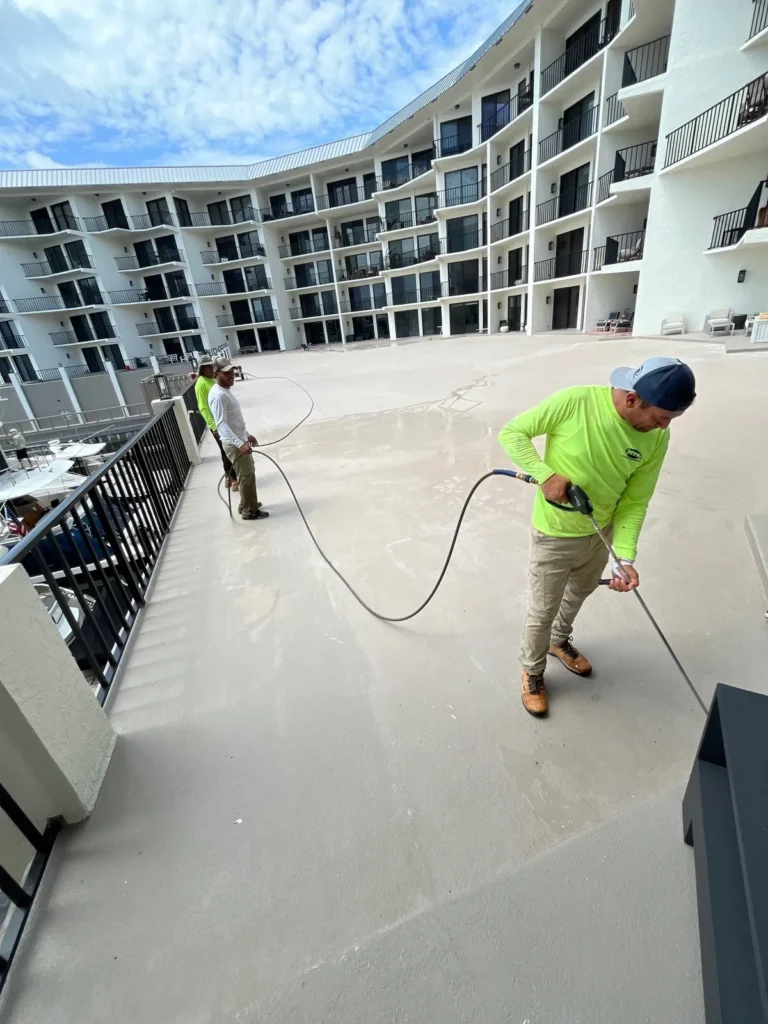
- Pressure washing to remove mildew, salt residue, and chalking paint before any new coating is applied
- Surface repair — filling cracks, replacing failed caulk, and addressing any minor stucco or wood damage
- Priming with a product matched to the substrate, especially over bare stucco, wood, or repaired areas
- Two full coats of exterior paint — a single coat rarely provides adequate film thickness for Florida’s UV and moisture exposure
- Proper cure time between coats, which is why weather-aware scheduling matters as much as the product itself
Skipping steps in this process is the single most common reason paint jobs fail within 2–3 years instead of lasting the 7–10 years a quality system should provide.
Color Considerations for Heat and Fade Resistance
Color choice affects both performance and longevity, not just appearance:
- Darker colors absorb more heat and UV energy, which can accelerate fading and thermal expansion stress on the paint film — though modern solar-reflective formulations have significantly narrowed this gap.
- Lighter and mid-tone colors generally show less visible fading over time and keep surface temperatures lower, which can benefit both the paint’s lifespan and a building’s cooling costs.
- HOA communities should also factor in community aesthetic guidelines and resale considerations, since color consistency across a community affects curb appeal and property values.
Coastal vs. Inland Properties: Does Location Change the Recommendation?
Yes. Properties within a few miles of the coast — common throughout Lee County’s Gulf-facing communities — face accelerated salt exposure and should prioritize:
- Marine-grade or coastal-rated exterior paint formulations
- More frequent rinsing/pressure washing schedules to remove salt buildup between full repaint cycles
- Extra attention to metal fixtures, railings, and trim, which corrode faster in salt air and can stain surrounding paint if not addressed
Inland properties in Broward County and similar areas still face significant UV and humidity exposure but can generally use standard high-quality exterior formulations without the coastal-specific additives.
How Often Should Exterior Paint Be Redone in Florida?
For most Florida properties using a quality 100% acrylic system with proper application, a repaint cycle of 7–10 years is realistic. Properties in harsher coastal or high-UV exposure areas may need to plan closer to the 5–7 year range, particularly on south- and west-facing walls that take the most direct sun.
HOA boards should treat exterior repainting as a planned reserve expense rather than a reactive one — waiting until paint is visibly failing usually means underlying surface damage (cracking, moisture intrusion) has already begun, adding repair costs to what should have been a straightforward repaint.
Understanding Paint Warranties in Florida's Climate
Manufacturer warranties on exterior paint can be misleading if they aren’t read closely, and Florida’s climate exposes the gaps in warranty coverage faster than milder regions do. When evaluating a paint system’s warranty, HOA boards and property owners should look at a few specific details:
- Is the warranty prorated? Many warranties reduce coverage value each year, meaning a “25-year warranty” may only pay out meaningfully if failure occurs in the first several years.
- Does it cover labor, or only product replacement? Some warranties only replace the paint itself, leaving the property to cover labor to strip and reapply — often the larger expense.
- Is it tied to a specific application process? Manufacturers often require documented surface prep and a specific coating system for the warranty to stay valid. A contractor who skips steps can unknowingly void coverage.
- Does it account for coastal exposure? Some warranties have reduced terms for properties near saltwater, worth confirming for coastal Lee County communities.
A reputable contractor will walk through warranty terms in plain language before work begins, rather than leaving the board to interpret fine print after a problem appears.
Common Mistakes That Shorten Paint Life in Florida
Beyond product selection, a handful of recurring mistakes cause most premature paint failures in Florida: painting over existing mildew or chalking without proper pressure washing, which guarantees early failure and can void warranty coverage; ignoring failed caulk at windows and trim joints, which cracks again in the same spots since the underlying gap wasn’t addressed; painting in poor weather conditions — high humidity, direct midday heat, or right before rain — which prevents proper film cure; using interior-grade paint outdoors, which lacks the UV inhibitors and mildewcide needed for exterior exposure; and skipping primer on repaired or bare substrate, which compromises adhesion regardless of topcoat quality.
Avoiding these mistakes typically has more impact on paint longevity than upgrading to a marginally more expensive product line — the contractor’s process matters as much as the paint itself.
Frequently Asked Questions
What is the best type of paint for Florida's humidity?
100% acrylic exterior paint with a high perm rating (vapor permeability) performs best in Florida’s humidity, since it allows moisture to escape from the substrate rather than trapping it and causing blistering or peeling.
Does more expensive paint always last longer in Florida?
Generally, yes — premium 100% acrylic formulations with solar-reflective and mildewcide additives outperform budget paints in UV resistance and moisture handling. However, proper surface preparation and application technique matter just as much as product quality.
How can you tell if exterior paint is failing due to moisture trapped underneath?
Blistering, bubbling, or peeling in sheets (rather than fine surface cracking) typically indicates moisture trapped beneath the paint film, often due to a vapor-impermeable product or inadequate surface prep before the previous paint job.
Should HOA communities repaint all buildings on the same schedule?
Most communities benefit from a phased repaint schedule based on each building’s sun exposure and condition rather than a single blanket schedule, since south- and west-facing buildings typically show wear faster than north-facing ones.
The Bottom Line
Choosing exterior paint for a Florida property isn’t about finding the most popular color or the lowest bid — it’s about matching the paint system, application process, and maintenance schedule to the specific climate stresses your building faces. A well-chosen, properly applied paint system protects the building envelope underneath it, which is often the more expensive asset to repair if moisture gets in.
MTD Painting & Construction has been selecting and applying exterior paint systems for HOA, commercial, and residential properties across Broward County, Lee County, and Florida for more than 20 years, matching product and process to each property’s specific exposure conditions.
Not sure which paint system is right for your property? Contact MTD Painting & Construction for a free exterior assessment and recommendation.